
What changed in 2023
This guide was first written when a license was the only lawful way to carry a concealed firearm in Florida. That is no longer the case. Since House Bill 543 took effect on July 1, 2023, a person who is legally able to possess a firearm under state and federal law may carry one concealed in Florida without a license.
So settle the first question before you spend anything: you are not legally required to hold a Concealed Weapon License in order to carry concealed in this state. Most of our students still apply for one anyway, and the reasons are practical rather than legal.
Why people still get the license
- It travels
- A Florida license is recognized by a number of other states under their reciprocity rules. Permitless carry applies inside Florida only. If you ever carry across a state line, the license is the document that gets discussed, and you should still check the rules of each state you enter before you go. Our reciprocity map lists every state, the conditions attached, and where the license is the thing that actually lets you carry.
- No three-day wait
- Buying a firearm from a licensed dealer normally means waiting three days before you can pick it up. That cooling-off period does not apply if you already hold a concealed weapon license.
- Proof of eligibility
- The license is a clean, official answer to the question of whether you are permitted to possess a firearm, which saves explaining yourself in the situations where it comes up.
- It comes with training
- The license requires documented live-fire training, and that is the part that actually matters. Carrying a firearm is a serious responsibility, and permitless carry changed how a firearm may be carried, not what you need to know to carry one safely.
Permitless carry did not remove every restriction either. You must still be at least 21, you must still carry valid identification, and firearms remain off-limits in places such as schools, airports and government buildings.
Firearms law and state fees change. Everything here reflects the process as we understand it, but the Florida Department of Agriculture and Consumer Services is the authority - verify the current requirements, forms and fees with them before you apply.
What to have ready
Two files and one honest self-check. Gather them first and the application itself is just typing.
A firearms training certificate
Your training must have included live fire using a real firearm and live ammunition. A classroom-only course does not satisfy the state, and this is the requirement that sends most people back to the start. If you trained with National Safety Center, your certificate meets the requirement as issued and you are good to go.
A digital passport-style photo
You can take it at home in about five minutes with a phone and a plain wall. The guidelines the state applies are the passport guidelines, and they are set out further down this page.
A check that you are eligible
Your payment is not refundable if you are determined to be ineligible for a Florida concealed weapon license, so it is worth five minutes to be certain. The state publishes a preliminary eligibility questionnaire, and we have built one that asks the same criteria without you leaving this site. The full list of disqualifiers is further down this page.
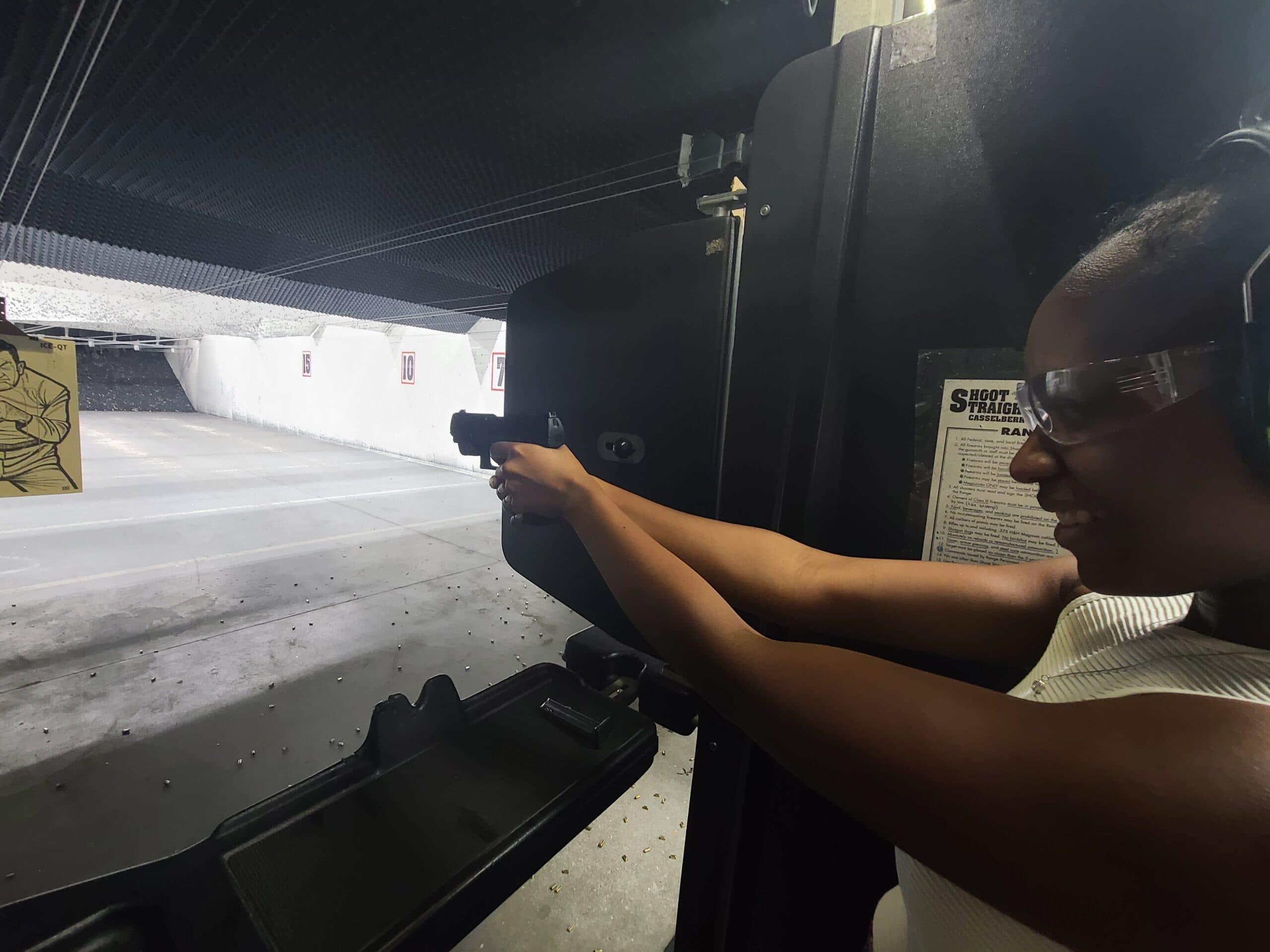
No certificate yet? Do the class first
Our concealed carry course is built around exactly what Florida requires, live fire included, fired in our classroom, with Simunition. You leave with the certificate the application asks for. It is not a range trip: if you want live ammunition on a lane, add the range session when you book. The private class runs on your date and time at $120 per student. No group dates are on the calendar yet.
Choosing how to apply
There are three routes: online, in person at a tax collector office, or by mail. We strongly recommend that you do not use the mail application. It is the slowest of the three and the easiest to get wrong, because nothing on the form tells you a field is missing until the rejection arrives weeks later.
The online portal opens a seven-step wizard, and it is the route this guide follows. Set aside fifteen uninterrupted minutes before you begin, clicking away in the middle of the first step will lose what you have entered.
The application, step by step
The state numbers these steps and this page keeps its numbering, so what you read here matches what is on your screen.
Step 1: Your information
Applications that come back rejected are usually rejected for incomplete or inconsistent paperwork rather than for anything disqualifying. Slowing down on this step is the single most useful thing you can do.
Section I is your applicant information - name, address, physical description, the ordinary details. Read every field back before you move on. Small mistakes here are what get applications rejected.
Section II is the set of qualifying questions that confirm you are eligible for a weapon license. Do not rush them, and do not answer from memory if you are unsure of a date or a disposition. Look it up.
Section III is a short oath and affirmation. Read it, then click Affirm and Complete.
Do not click the Home button at any point in this step. It discards everything you have entered.
You are then assigned a tracking number. Save it somewhere you will find it again. It is how you check the status of your application for the next three months.
You are not finished. The Print Application button on the confirmation screen leads a lot of people to believe they are done. Click Next and carry on to the upload steps.
Step 2: Your photo
Click Next and upload the passport-style photo that will appear on your concealed firearm license. If you have not taken it yet, the guidelines are further down this page and it takes about five minutes.
Step 3: Your training certificate
Click Next and upload the certificate of completion from your firearms training class. The training must have included live fire using a firearm and ammunition. An NSC certificate satisfies this as issued.
Step 4: Supporting documents
Most people upload nothing here and move straight on.
This step exists for documents that apply to some applicants and not others: naturalization papers if you were not born in the United States, proof of legal residency, or an honorable discharge from the armed forces. If your photo includes a head covering worn for religious reasons, the written statement about it belongs here too.
Step 5: Fingerprinting
The wizard gives you your fingerprinting instructions and the reference number the fingerprinting site will need. Read them, print the page, and treat this as the step that sets your timeline, nothing starts processing until your prints are in. The full fingerprinting sequence is below.
Steps 6 and 7, Payment and confirmation
These two are self-explanatory. Make the payment, then print or save your application confirmation before you close the window.
Fingerprinting
Get this done as soon as you can. Your application does not begin processing until your fingerprints are received, so every day you leave it is a day added to the end of the wait.
Have your fingerprints taken somewhere that offers a digital fingerprinting service. The easiest place we have found in our area is the Altamonte Police Department, and you can schedule an appointment through their COPS system.
Bring the printout of your completed application and make sure they use your reference number. It begins with T and appears at the top of the confirmation page from the previous step. They will know what to do with it.
You will leave with a fingerprinting confirmation form. The TCN is the number in the top left that begins with 70. Go to the FDLE website and use it to complete the payment for the fingerprinting.
Your application will be rejected if you do not complete the fingerprint payment within 30 days.
After you submit
Processing can take as long as 90 days from the point your fingerprints are received, and your license should arrive by mail within that window.
You can check where the application has got to at any time using the tracking number from Step 1. The Department of Agriculture and Consumer Services publishes a status lookup on the same licensing site you applied through.
If something is missing, this is where you will hear about it, which is the argument for having been slow and careful on Step 1.
Taking the passport-style photo
You do not need a photo booth or a studio. A phone, a plain wall and good light will pass.
Prepare for the picture
Find a white or cream-colored background, a wall or a poster board will do. Make sure there is plenty of light so there are no shadows or glare on your face or around your head and body. That might mean moving near a window, or switching household lights on or off.
Check your appearance
Wear your everyday clothing and hairstyle. Uniforms and costumes are not accepted unless they are worn daily for religious reasons, and garments or head coverings worn for religious purposes need a written statement, which you upload with your supporting documents. Headphones and wireless hands-free devices are not acceptable. Prescription glasses, hearing devices and similar articles may be worn, but glare on glasses is not acceptable. Pose with a neutral expression and both eyes open.
Shoot, edit, save
Frame the shot with plenty of headroom and room around your arms, cropped just below the shoulders. Better too zoomed out than too zoomed in, since you can always crop afterwards. Take a few, transfer them to your computer, and use any cropping and sizing tool to set the final crop and file size.
Who is eligible
Any resident of the United States who is 21 years of age or older and is a citizen or permanent resident alien of the United States may apply, provided none of the reasons below applies to them.
You do not have to live in Florida. Anyone living in the United States can apply, as can active-duty military residing abroad. You do not have to own a firearm either.
Reasons an applicant is ineligible
Any one of these will stop an application. Read them before you pay, because the fee is not refundable if you are determined to be ineligible.
- The physical inability to handle a firearm safely.
- A felony conviction, unless civil and firearm rights have been restored by the convicting authority.
- Adjudication withheld or sentence suspended on a felony or misdemeanor crime of violence, unless three years have elapsed since probation or other conditions set by the court were fulfilled.
- A conviction for a misdemeanor crime of violence in the last three years.
- A conviction for violation of controlled substance laws, or multiple arrests for such offenses.
- A record of drug or alcohol abuse.
- Two or more DUI convictions within the previous three years.
- Being committed to a mental institution, or adjudged incompetent or mentally defective.
- Failing to provide proof of proficiency with a firearm.
- A domestic violence injunction, or an injunction against repeat violence, currently in force.
- Renouncement of U.S. citizenship.
- A dishonorable discharge from the armed forces.
- Being a fugitive from justice.
Common questions
- How much is a concealed weapons permit in Florida?
- The total state fee is $97, a $55 application fee plus a $42 fingerprint-processing fee. Submitting your application at a tax collector office may add a convenience fee on top. The total state renewal fee for a Florida resident is $45. Fees are set by the state and do change, so confirm the current amounts before you pay.
- Do I need to own a firearm in order to apply?
- No. You do not need to own a firearm in order to apply for a Florida concealed weapon license, and you do not need one to take the class either. We provide a firearm for training if you do not have your own. Plenty of students train, qualify and apply before they ever buy one.
- Do I need a license in order to buy a firearm in Florida?
- No. If you buy from a licensed dealer, the dealer obtains approval from the Florida Department of Law Enforcement, and you wait three days before picking up the firearm. That cooling-off period does not apply if you already hold a concealed weapon license.
- Do you have to live in Florida to apply?
- No. Anyone living in the United States can apply. You must be a U.S. citizen, a legal resident alien residing in the United States, or active-duty military residing abroad.
- Can I take the firearms class online?
- We teach the theory online, either as a virtual instructor-led session or at your own pace. You still come in for the practical part afterwards, because the certificate you upload has to show live fire. In the concealed carry class that happens in our classroom, firing Simunition, non-lethal training ammunition - which is what Florida accepts. A live-fire session on a range is an optional add-on.
- Can someone at NSC check my application before I submit it?
- Yes. Concealed carry application support is an add-on you can select when you book the private CCW class. We sit down with your application, make sure it is error-free before it goes in, and take the hassle out of the process.
- Can I carry a gun without a concealed weapons permit in Florida?
- Yes. Since July 1, 2023, Florida has allowed permitless carry for people who are legally able to possess a firearm. You must still be 21 or older, still carry valid identification, and places such as schools, airports and government buildings remain off-limits. The license is no longer a legal requirement for carrying concealed in Florida, but it keeps the practical benefits set out at the top of this page. Read our full write-up on permitless carry.
- Still not sure about something?
- Call us. We would far rather answer a question on the phone than have you guess at an answer on an application that costs $97 and is not refundable. (407) 479-3790